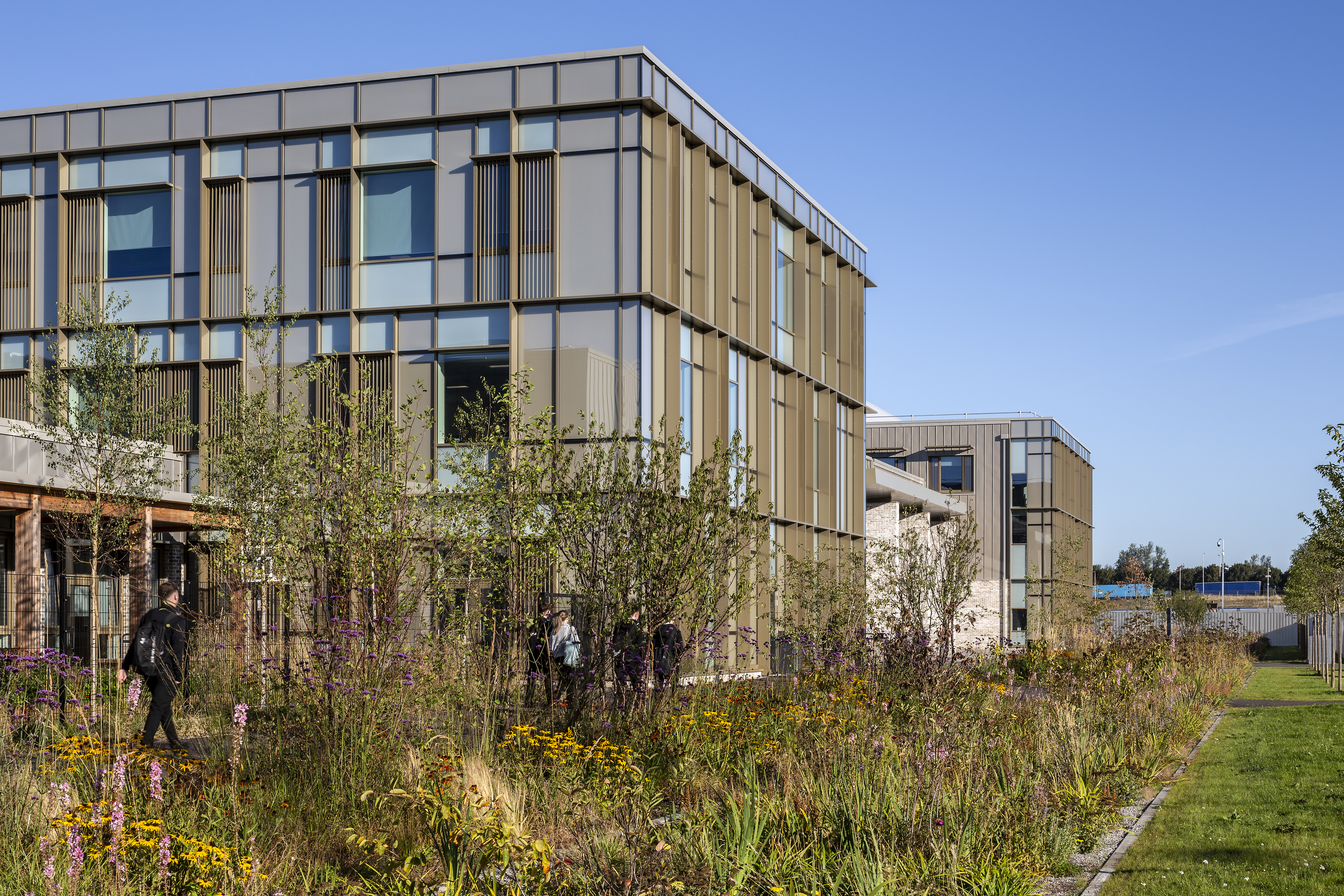
The Project

Theatr Clwyd in Mold is one of Wales’ most important cultural venues and the largest producing theatre in Wales. Originally opened in the 1970s, the building has undergone a major three-year redevelopment designed to safeguard its future as a theatre, creative hub and community destination.

The £47 million transformation has modernised the venue while retaining the character and importance of the original building. The project has included upgraded performance spaces, a refurbished cinema, new rehearsal and community areas, improved backstage facilities, a new first-floor restaurant, a ground-floor café and shop, and indoor and outdoor play spaces for children.

Sustainability was central to the redevelopment. The renewed venue has been designed to reduce operational energy use and improve comfort through fabric upgrades, fossil-fuel-free building services, air source heat pumps, rainwater harvesting, biodiversity measures and future-ready infrastructure for solar PV. Within this wider low-carbon approach, ventilation had a vital role to play in supporting indoor air quality, energy efficiency and occupant comfort across a highly varied and complex cultural building.

The Challenge

Theatr Clwyd presented a very different challenge from a standard commercial project. As a theatre and arts centre, it brings together a wide range of spaces with different ventilation requirements, from auditoria, cinemas and rehearsal areas to workshops, offices, hospitality spaces, circulation zones and community facilities.

Occupancy levels can vary significantly throughout the day and evening, with intense periods of use during performances, events and dining, followed by quieter periods when only certain areas are occupied. The ventilation strategy therefore needed to support flexible operation while helping the project team meet wider sustainability ambitions.

The building’s cultural use also placed a strong emphasis on acoustic performance. In performance, rehearsal and cinema spaces, ventilation must deliver fresh air without creating intrusive background noise. At the same time, the system needed to be robust enough for a public venue that will be used intensively by audiences, artists, staff and the local community for many years to come.

The Solution

With considerable experience in theatres and performance spaces, building physics and environmental engineering consultants Skelly & Couch designed a full systems overhaul at Theatr Clwyd, targeting an 80% cut in operational carbon emissions. It was a fabric-first retrofit designed to dramatically improve air tightness, delivering year-round comfort and reduced energy demand.

High-performance insulation and upgraded windows have been installed to stabilise indoor temperatures and eliminate drafts, with intelligent window automation deployed across public foyers, offices and other locations suitable for natural ventilation, wherever possible. Where natural ventilation is inappropriate, MVHR has been installed to provide filtered fresh air whilst also minimising energy loss.

Green roofs have been used to enhance biodiversity.

Photos by Mark Carline

Mechanical Ventilation’s Role

Stephen White, Director at Skelly & Couch, led the development of the mechanical, electrical and environmental design on the project. Skelly and Couch specified Nuaire mechanical ventilation systems based on their previous positive experience with Nuaire.

A comprehensive package of Nuaire commercial ventilation equipment was chosen for the redevelopment, selected to support the different demands of the building. The installation included eight XBOXER XBC+ supply and extract heat recovery units, four SQUIF fans, three 9-inch flat roof fans, two OPUS units and two ILMEC 200 in-line mixed flow fans.

Nuaire’s XBOXER XBC+ heat recovery units have been installed in areas that have no or limited natural ventilation, such as dressing rooms, recording studios, control rooms, storage areas and WCs. These supply and extract units provide filtered fresh air while extracting stale air from occupied areas, recovering the heat that would otherwise be lost. This makes them particularly well suited to projects where indoor air quality and energy efficiency must work together.  The XBOXER range also has low noise levels, which was, according to Stephen “a major consideration” as the units have been used to serve a recording studio, amongst other areas.

Nuaire’s SQUIF single fans were selected where high-pressure development was required, such as the two commercial kitchens. SQUIF features a backward curved centrifugal impeller and is suitable for demanding ducted systems, including applications with higher resistance. This made it a useful part of the overall ventilation strategy for a complex building where plant had to serve a range of spaces and routes.

The project also used Nuaire’s OPUS fans for theatrical haze extract. OPUS fans are compact wall and ceiling units designed to combine high performance with low noise.

Two ILMEC 200 units were also included. ILMEC is Nuaire’s in-line mixed flow tube fan range, offering an efficient commercial extract solution where ducted in-line ventilation is required, such as the theatre’s print rooms. The use of ILMEC helped provide a flexible approach across areas where a dedicated local extract solution was needed.

The flat roof fans completed the package, supporting extract requirements through the roof construction and enabling the wider system to be integrated into the refurbished building.


The Outcome

The completed ventilation installation forms part of a wider building services strategy designed to future-proof Theatr Clwyd and support its ambition to operate as a sustainable, welcoming and comfortable cultural venue. The theatre now has a confirmed airtightness of 6.18 m³/h/m² @ 50 Pa, and (very soon) a BREEAM ‘Very Good' rating.

By combining heat recovery, commercial extract and local ventilation products, Nuaire contributed to the wider ventilation strategy for this complex refurbishment project. Its equipment plays an important role in supporting indoor air quality and occupant comfort across a diverse mix of public, performance, hospitality, workplace and community spaces.

For audiences, artists and staff, the ventilation contributes to a more comfortable internal environment. For the project team, it supports the wider low-carbon ambitions of the redevelopment by helping reduce unnecessary heat loss while maintaining the fresh air supply required in a busy public building.

Theatr Clwyd demonstrates how major cultural buildings can be successfully renewed for modern expectations of comfort, accessibility and sustainability. Nuaire’s ventilation equipment plays an important role in that transformation, helping the venue continue to serve North Wales as a creative, community-focused and future-ready cultural landmark.